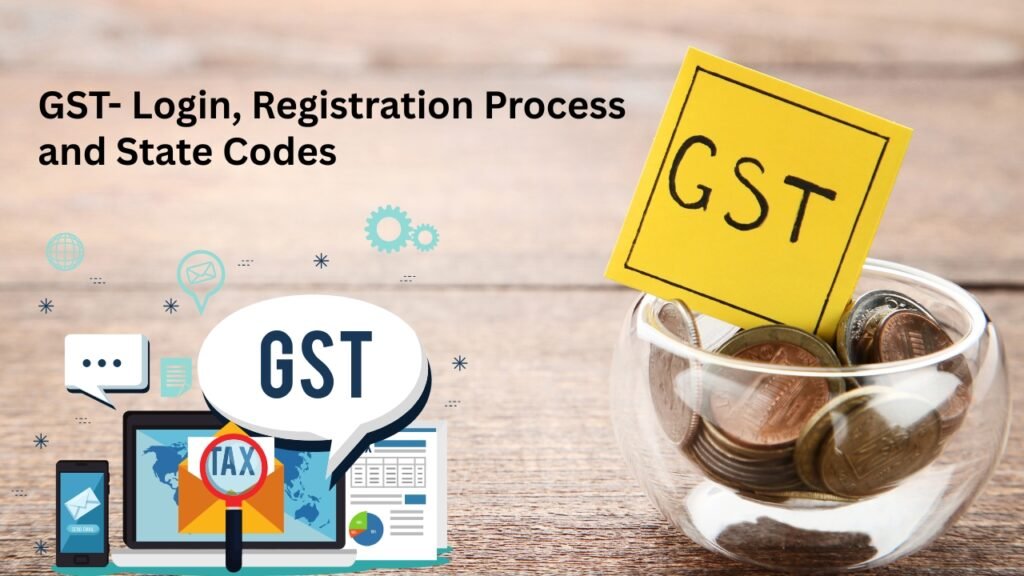
GST is one of the most revolutionary reforms in the history of Indian taxation. It was launched on 1 July 2017, and it replaced a slew of indirect taxes levied by the central and state governments, comprising service tax, value-added tax, and excise duty. The objective of GST is to make the tax structure uniform, more transparent and simpler.
If you are a business owner, a taxpayer, or you are just curious to find out the full meaning of GST, this post has got you covered. It will show you the basics you need to know about GST; everything ranging from the GST full form, GST login, GST portal login, GST registration, GST calculator, GST verification, Know Your GST and GST state code list.
What is GST? (GST Full Form and Meaning)
The complete name of GST is known as the Goods and Services Tax. It is a destination-based tax on the supply of goods and services. GST applies to producers, sellers and service providers, thus a full-fledged tax structure that removes the cascading effects of various kinds of taxes.
Types of GST in India
- CGST (Central Goods and Services Tax ) – Charged by the Central Government.
- SGST (State Goods and Services Tax) – Levied by the State Government.
- IGST (Integrated Goods and Services Tax) – Applicable on the sale of goods as well as services between states.
- UTGST (Union Territory GST) – Levied in Union Territories without a legislature.
Objectives of GST
- One Nation, One Tax: Common tax rates and structure for the entire nation.
- No cascading effect: No tax on tax on goods and services.
- Doing business made easy: Compliance made easy for businesses.
- Transparency in Taxation: All transactions are digital.
GST Portal – The Digital Hub
https://www.gst.gov.in is the online address of the official GST portal where every activity related to GST is undertaken. It provides services such as:
- GST Portal Login
- GST Registration
- GST Return Filing
- Know Your GST
- GST Verification
- GST Calculator
- Track GST Status
How to Perform GST Portal Login? (GST Portal Login Guide)
GST portal login is the lifeblood for businesses to function when it comes to their tax-related operations.
Steps to GST Portal Login
- Visit gst.gov.in.
- Click on ‘Login’ at the top right corner.
- Enter:
- Username
- Password
- Captcha Code
- Click Login.
Pro Tip: Check your profile often, as new features are added and enabled daily.
New User? How to Register for GST
If your business has a turnover of over ₹40 lakhs annually (₹20 lakhs for certain states), then you need to register for GST.
Steps for GST Registration
- Visit gst.gov.in.
- Click ‘New Registration’.
- Fill in details:
- Business Name
- PAN Number
- Email ID & Mobile Number
- Verify via OTP.
- Submit required documents:
- PAN Card
- Aadhaar Card
- Address Proof
- Bank Details
- After verification, you’ll receive your GSTIN (Goods and Services Tax Identification Number).
Must Read: TAFCOP Portal | What is an E-Way Bill? | Mahadbt Farmer Login
Know Your GST – Search GST Details
Know Your GST is a facility by which you can validate GSTIN. It enables businesses to verify that the supplier’s GST number available to them is legitimate.
How to Verify GST Number
- Go to the GST Portal.
- Click Search Taxpayer > Search by GSTIN/UIN.
- Enter the GSTIN and Captcha.
- Click Search.
GST Calculator – Calculate GST Very Easily
Figuring out GST on your own can be difficult, but it is easy with a GST calculator.
GST Calculation Formula
- Amount of GST = (Value/100) × 18 or 12 or 28 or 6 or 3 or else.
- Net Price = SP + GST Amount.
- Example:
- Product Price = ₹1,000
- GST Rate = 18%
- GST Amount = (1000 × 18) / 100 = ₹180
- Total Price = ₹1,000 + ₹180 = ₹1,180
You can also use the GST calculator available on the GST portal for an instant solution.
GST Status – Track your Application
Post application of GST registration, you can track your GST status online.
Steps to Check GST Status-
- Go to the GST portal.
- Services, and then click Track Application Status.
- Enter ARN (Application Reference Number).
- Click Search.
You will find out if your application has been approved, pending or rejected.
GST State Code List- Here’s All You Need To Know
Every entity registered under GST is allotted a unique 15-digit alphanumeric Goods and Services Tax Identification Number (GSTIN). Now this GSTIN is an organized number; it moves in a particular pattern and discloses important particulars related to the taxpayer.
The State Code is the first two digits in the GSTIN, which is as per the Indian Census Code. These are codes to designate where the business is registered. For instance, if a GSTIN code begins with 27, it indicates the company is registered in Maharashtra.
Why are GST State Codes important?
- Tax Vet Tax ID: The state code will guarantee the correct tax ID for that particular state.
- Invoice Validation: In the process of verifying GST invoices, the state code provides a mechanism to verify whether the GSTIN provided is authentic or not.
- Cross-Checking for IGST/CGST/SGST: It assists in establishing whether the transaction is an intra-state sale (i.e., within a state) or an inter-state sale (i.e., from one state to another) to determine the applicability of CGST + SGST or IGST.
- Error Detection: Incorrect state codes can result in compliance errors, invoice discrepancies and fines.
Structure of GSTIN
A GSTIN looks like this:
- 27ABCDE1234F1Z5
- 27 → State Code (Maharashtra)
- ABCDE1234F → PAN of the Enterprise
- 1 → Entity Code
- Z → Default Alphabet
- 5 → Check Code
Complete GST State Code List
The following are the codes of States and Union Territories in GSTIN.
| State / UT | GST State Code |
| Jammu & Kashmir | 1 |
| Himachal Pradesh | 2 |
| Punjab | 3 |
| Chandigarh | 4 |
| Uttarakhand | 5 |
| Haryana | 6 |
| Delhi (NCT) | 7 |
| Rajasthan | 8 |
| Uttar Pradesh | 9 |
| Bihar | 10 |
| Sikkim | 11 |
| Arunachal Pradesh | 12 |
| Nagaland | 13 |
| Manipur | 14 |
| Mizoram | 15 |
| Tripura | 16 |
| Meghalaya | 17 |
| Assam | 18 |
| West Bengal | 19 |
| Jharkhand | 20 |
| Odisha | 21 |
| Chhattisgarh | 22 |
| Madhya Pradesh | 23 |
| Gujarat | 24 |
| Daman & Diu | 25 |
| Dadra & Nagar Haveli | 26 |
| Maharashtra | 27 |
| Karnataka | 29 |
| Goa | 30 |
| Lakshadweep | 31 |
| Kerala | 32 |
| Tamil Nadu | 33 |
| Pondicherry | 34 |
| Andaman & Nicobar Islands | 35 |
| Telangana | 36 |
| Andhra Pradesh | 37 |
| Ladakh | 38 |
Famous GST State Codes You Should Know
- 06 GST State Code – Haryana
- 07 GST State Code – Delhi
- 08 GST State Code – Rajasthan
- 24 GST State Code – Gujarat
- 27 GST State Code – Maharashtra
- 29 GST State Code – Karnataka
- 33 GST State Sode for GST – Tamil Nadu
- 36 GST State Code – Telangana
Must Read: Jan Andolan Portal | RCH Portal | Swasthya Sathi Card
Impact of GST State Code on Invoice
When you issue a GST invoice:
- If the seller and buyer’s state code is the same, CGST + SGST is to be levied (intra-state supply).
- In addition, a combination of central value-added tax and state value-added tax or a combination of central excise and VAT was levied with respect to the sale of goods and the provision of or agreement to provide services. If the seller and buyer state codes are different, IGST is applicable (inter-state supply).
Example:
Seller GSTIN is 27 (Maharashtra), and the first 2 digits of the seller’s GSTIN are not 27.
Buyer GSTIN series commencing with 07 (Delhi)
→ The sale crosses the border, hence IGST is levied.
Common Mistakes in State Codes
- Wrong State Code in GSTIN: Gives errors of invalid GSTIN.
- Mismatch in Invoice: Errors in State codes can lead to discrepancies in your GST return and, eventually, penalties.
How to Verify GST State Code?
You may check a GST state code by:
- Verification of the first two digits of GSTIN.
- Through the Know Your GST portal.
- Cross-verified with the GST state code list shown above.
Benefits of GST for Businesses
- Simplified Taxation
- Elimination of Multiple Taxes
- Transparency and Accountability
- Boost to the Economy
- Ease of Compliance
Challenges of GST
- Technical Glitches on Portal
- Complex Filing Process
- Frequent Changes in Rules
- Impact on Small Businesses
Effects of GST on the Indian Economy
GST has helped:
- Reduce tax evasion.
- Increase government revenue.
- Enhance traceability in the supply chain.
GST on Tobacco, Sin Goods: What about the proposed 35% Increase?
GST Council has recently hit the headlines: Discussion about raising taxes on tobacco products and other sin goods. The proposal contemplates Goods and Services Tax on aerated drinks, cigarettes and tobacco-related products at 35 percent. There are two reasons why the increase is justified:
- Discouragement: Since these products are hazardous to health, a tax increase discourages consumption.
- Generate Revenue: Extra money in tax receipts goes to health and welfare programs.
Should this proposed increase become reality, the impact on manufacturers, importers/distributors, and consumers will be significant and companies should understand the significance of compliance with products in this category.
Next Steps in GST Reforms: Simplified Slabs and Reduced Tax Rates Explained
The government is weighing options for a massive overhaul of GST to simplify the tax structure. Now, GST has four slabs — 5%, 12%, 18% and 28 %, but there is buzz that the slabs may be brought down to just two or three slabs. Proposed changes include:
- Combining the 12% and the 18% slabs into a single slab for ease of calculation.
- Lowering charges for necessities so that they are affordable.
- Bringing in scale rates to minimize classification disputes.
The changes are expected to make the process of GST business-friendly, lower the compliance costs, and include more taxpayers in GST.
The New 3-Year Time Limit for GST Return Filing: What You Need to know
Recent amendments have brought three years as the time limit to file GST returns after their due date. This means:
- Businesses will be able to file or amend returns that are less than three years old.
- All outstanding tax liabilities afffly negative/rectification beyond this period will not be allowed.
This reform also provides timely enforcement and reduces contentious long-term litigation. SMEs need to be more proactive in filing returns so that they do not miss out on credits on time and pay penalties.
New ITC Rules Explained: 100% Invoice Matching & E-Invoicing Mandatory Now
ITC is considered to be the backbone of GST and the rules related to it have been made more stringent in the recent past:
- 100% ITC will now be allowed on the basis of invoice matching. Which is, then your supplier has to upload the invoice on the GST portal; otherwise, you can not take credit.
- Compulsory e-invoicing has been widened to companies having a turnover exceeding ₹5 crore, which means you need to have e-invoicing software for smooth compliance.
The changes are intended to crack down on fake invoicing and tax fraud, but companies must upgrade their systems to remain in compliance.
Why the HSN Code Reporting Requirement under Phase III has Been Postponed- And How to Get Prepared
The Government had planned to roll out Phase III HSN code reporting, mandating businesses to report six-digit HSN Codes for supplies of all goods and services in the invoices. But this stage is being held back, as a result of technical difficulties and industry disquiet.
What you should do:
- Begin recording HSN codes for all products kept as inventory.
- Update your billing system to recognize codes with six numbers.
- Educate your staff to help ensure the correct code mapping so that there will be no penalties once the rule is live.
Getting a head start will help businesses avoid last-minute compliance headaches.
Latest GST News: New Refund Rules, E-way Bill 2.0 & Decisions of the GST Council
Here is what recent meetings of the GST Council have brought up:
- Ease of Refund: Online refund process for the exporters and inverted duty structure.
- E-way bill 2.0: Significant features such as auto-validation of vehicle number, linkage with FASTag to curb tax evasion
- Aurangzeb’s Compliance for high-risk persons: Risk-based checks and audit for firms found to be non-compliant.
It’s good to keep up with these changes to guarantee that all runs smoothly and to avoid any compliance penalties.
Conclusion
The so-called GST has made taxation a level playing field in India. From GST login, GST portal registration, to utilising the GST calculator, all can be carried out through online means. GST State Codes, Compliance Rules & How To Utilize Know Your GST Knowing GST State Codes, Compliance Rules, and Use of “Know Your GST” Can Make You Run Your Business Smoother.
FAQs about GST
Q-1: What is the GST full form?
A- Goods and Services Tax.
Q-2: How do I perform GST login?
A- Visit gst. gov.in, fill in the username, password and captcha.
Q-3: How to see my GST status?
A- Check on the status of your application via the GST portal.
Q-4: What is ‘Know Your GST’?
A- It supports you in checking your GSTIN details online.
Q-5: As a Small business, do I have to pay GST?
A- Yes, up to 20 turnovers, exceeding ₹40 lakhs (₹20 lakhs in a few states).
Q-6: Can I apply for GST online?
A- Yes, through the GST portal.
Q-7: How to calculate GST manually?
A- Use the equation: (Cash × GST percentage) / 100.
Also Read: MP Bhulekh | MP Bhu Naksha | MP Bhu Abhilekh